Home » Supporting Family Caregivers Who Are Deaf or Hard of Hearing
Supporting Family Caregivers Who Are Deaf or Hard of Hearing
Caregivers who are Deaf or hard of hearing manage the same appointments, medication schedules, and phone calls as any family caregiver, yet much of the healthcare system runs on spoken conversation. Federal disability law, relay services, and a few planning habits close most of that gap. Under the Americans with Disabilities Act (ADA), hospitals must communicate effectively with family members and companions who are Deaf or hard of hearing, not only with patients. November is National Family Caregivers Month, which makes this a good time to set up a communication plan before the next appointment or emergency.
Key Takeaways
Hospitals covered by the ADA must provide effective communication to caregivers who are Deaf or hard of hearing, not only to patients.
Hospitals should not ask family members to interpret, and hospitals cannot charge an extra fee for interpreters or other communication aids.
Relay services let caregivers coordinate care by phone, and dialing 7-1-1 reaches a relay operator for TTY calls anywhere in the United States.
A clear-window mask keeps a provider’s face visible, but a clear mask does not replace a qualified interpreter when one is needed.
Why Caregivers Who Are Deaf or Hard of Hearing Need Their Own Plan
National Family Caregivers Month is an annual November observance that honors people who provide care to family members and friends. The Administration for Community Living (ACL) describes National Family Caregivers Month as a time to build awareness of caregiving challenges and expand support for caregivers, and the nonprofit Caregiver Action Network leads the observance each year. ACL also notes that families are the primary source of support for older adults and people with disabilities in the United States.
Most caregiving advice assumes the caregiver hears well and the patient may not. Safe’N’Clear has covered that situation in a guide on masks and hearing loss for caregivers. This guide flips the relationship. When the caregiver is the person who is Deaf or hard of hearing, a pharmacy phone call, a rushed discharge conversation, or a provider behind an opaque mask can each become a barrier. Caregivers who are Deaf or hard of hearing often hold the medication list and care history, so planning around those barriers protects the patient as much as the caregiver.
What the ADA Requires for Deaf and Hard-of-Hearing Family Members
The ADA requires hospitals to provide effective communication for patients, family members, and visitors who are Deaf or hard of hearing. Effective communication is the ADA obligation to provide the aids and services a person who is Deaf or hard of hearing needs, matched to that person’s communication method and to how complex the conversation is. A note exchanged at a gift shop and a conversation about treatment options call for very different tools.
Hospitals Must Include the Caregiver, Not Only the Patient
The U.S. Department of Justice ADA Business Brief on communicating in hospital settings gives examples where the family member, not the patient, is the person who is Deaf or hard of hearing. The examples include a deaf guardian of a minor patient and a spouse or partner who is hard of hearing and needs to discuss prognosis and treatment options. The brief also tells hospitals to consult each individual about which aids or services will work, because people with hearing disabilities communicate in different ways. For you as a caregiver, that guidance means you can state a preferred method up front, whether a qualified sign language interpreter, an oral interpreter, real-time captioning known as CART, or written notes for simple exchanges.
Family Members Should Not Be Asked to Interpret
The same Department of Justice guidance calls the practice of asking family members or companions to interpret inappropriate, because the emotional weight of a medical emergency can make accurate interpretation difficult. That principle protects caregivers in two directions. A hearing relative should not be pulled in to interpret for a Deaf caregiver, and a Deaf caregiver should not have to rely on a child or sibling to follow a diagnosis. Hospitals also cannot charge patients or other people with hearing disabilities an extra fee for interpreters or other communication aids. The guidance has limits. A hospital does not have to provide an aid that would fundamentally alter the hospital’s services or create an undue burden. The Department of Justice also describes business briefs as informal guidance rather than binding rules, so naming your needs early produces the best results.
Using Relay Services to Coordinate Care by Phone
Telecommunications Relay Service (TRS) is a telephone service that lets people with hearing or speech disabilities place and receive calls with help from a communications assistant or captioning technology. For caregivers who are Deaf or hard of hearing, caregiving runs on calls to pharmacies, specialists, insurers, and home health agencies. The table below compares three common relay options by who they serve and how a caregiver connects.
Relay option
Best fit
How to connect
TTY relay
Caregivers who type messages on a text telephone (TTY)
Dial 7-1-1 anywhere in the United States to reach a relay operator
Video Relay Service (VRS)
Caregivers whose primary language is American Sign Language (ASL)
Internet-based video equipment. 7-1-1 does not connect to VRS
IP Captioned Telephone Service (IP CTS)
Caregivers who can speak and have some residual hearing
An existing voice telephone plus a computer or other web-enabled device. 7-1-1 does not connect to IP CTS
Two practical habits make relay calls smoother. Some people hang up on relay calls because they mistake the communications assistant for a telemarketer, so tell each office on your loved one’s care team to expect relay calls and to stay on the line. For emergencies, the Federal Communications Commission (FCC) advises TTY users to call 911 directly rather than placing a relay call through 7-1-1.
How Caregivers Who Are Deaf or Hard of Hearing Can Prepare for Appointments
A short routine before each appointment turns legal rights into a smooth visit. The steps below work for hospital stays, specialist visits, and home health intake, and they follow the Department of Justice guidance described above.
Contact the office ahead of time and name the aid you need, such as an ASL interpreter or CART captioning, along with the date, time, and department.
Ask the care team to note your communication preference in your loved one’s record, so the request does not start over at every visit.
Bring the essentials in writing, including the current medication list, recent changes, and your questions.
Ask providers to face you, keep the room well lit, and speak one person at a time.
Request discharge and medication instructions in writing before you leave.
Each step reduces the chance that an important detail depends on a single spoken sentence. Written instructions also let hearing relatives follow the same plan without acting as interpreters. For everyday habits that make conversations easier at home and in public, see Safe’N’Clear’s best practices for communicating with Deaf and hard-of-hearing people.
Where Clear Masks Fit for Caregivers Who Are Deaf or Hard of Hearing
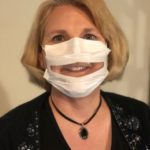
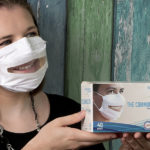
Masked providers create a specific barrier for caregivers who speechread or rely on facial expression, because a standard surgical mask covers the mouth. Safe’N’Clear, Inc. supplies The Communicator™ Procedural Face Mask, an FDA cleared and ADA effective surgical mask with a clear, anti-fog window, in ASTM Level 1 and ASTM Level 3. For caregivers who are Deaf or hard of hearing, The Communicator solves the masked-face problem directly, since the provider stays protected while the mouth and facial expressions stay visible. Facilities comparing options can review Safe’N’Clear’s clear-window mask protection for healthcare.
A clear mask has limits, and Safe’N’Clear states those limits plainly. A clear mask is not a substitute for an interpreter or another auxiliary aid when one is required. The Department of Justice notes that even people trained in speechreading may need an oral interpreter to follow spoken words well, and ASL users need a qualified sign language interpreter for complex conversations. Clear masks work best alongside those services, a combination covered in Safe’N’Clear’s guide to communicating with Deaf patients at the front desk.
Building a Communication Plan This National Family Caregivers Month
Caregivers who are Deaf or hard of hearing have clear rights under the ADA and practical tools in relay services, written plans, and accessible PPE. Use National Family Caregivers Month to name your communication needs with each provider, set up the relay options you use most, and share this guide with your loved one’s care team. If home care staff or providers need masks that keep their faces visible, browse The Communicator™ ASTM Level 1 and ASTM Level 3 masks in the Safe’N’Clear shop, where ordering by the case saves 10% on Level 1 and 11% on Level 3.